


Not long ago, I was sitting across the table from a pharmaceutical executive discussing a technology that had the potential to change preclinical research. The science was impressive. The engineering was elegant. The vision was ambitious.
But the conversation kept returning to the same question.
“How do we know this is what the industry actually needs?”
It wasn’t a question about the technology. It was a question about translation.
That conversation has repeated itself more times than I can count over the years. Brilliant scientists develop remarkable innovations. Pharmaceutical companies recognize the limitations of existing models. Investors fund promising ideas. Regulators encourage modernization.
Yet somehow, these groups often move forward independently, each solving a different piece of the same puzzle.
The result is a bottleneck that has quietly slowed therapeutic development for decades.
Today, biopharma companies are under tremendous pressure to improve the predictability of preclinical research. Drug development continues to be one of the most expensive and risky endeavors in healthcare, with failures frequently occurring because traditional models fail to predict how therapies will behave in humans.
At the same time, an entirely new generation of biotechnology companies is building sophisticated human-relevant models, AI-enabled platforms, organ-on-chip systems, advanced computational tools, and functional biological assays designed to address those very shortcomings.
But these innovators face their own challenge.
Building breakthrough technology is one thing. Building the right technology is something entirely different.
Without continuous engagement from the companies that will ultimately use these platforms, developers are often forced to make critical product decisions without sufficient real-world feedback. Years of research and millions of dollars can be invested into capabilities that don’t fully align with industry needs.
It creates an unfortunate catch-22.
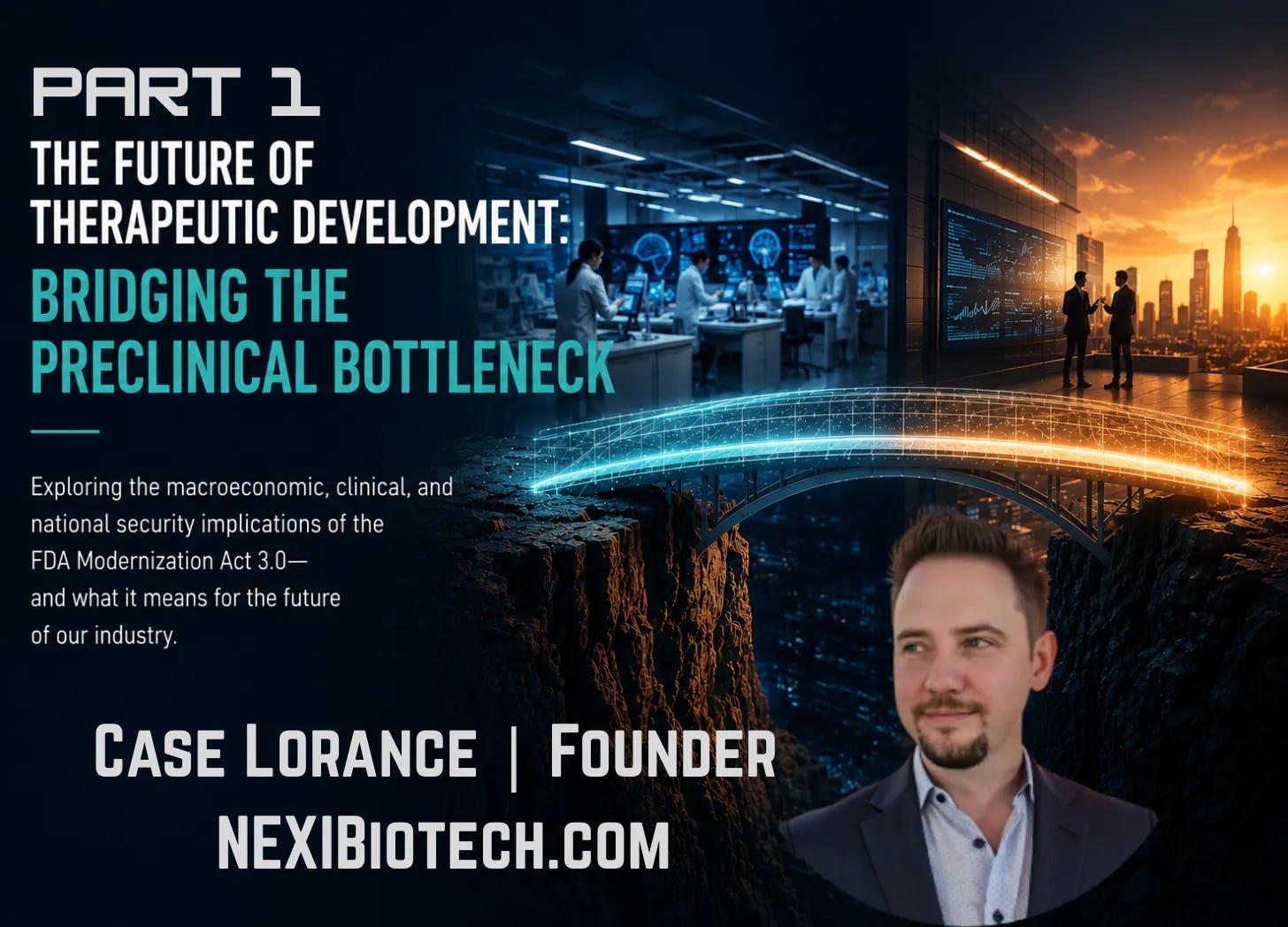
Biopharma needs better tools before it can confidently replace outdated approaches.
Technology developers need experienced biopharma partners to validate and shape those tools before they can become industry standards.
Neither side can move as quickly as it could without the other.
As the FDA recently closed the public comment period for the FDA Modernization Act 3.0, this challenge has become impossible to ignore.
The conversation is no longer centered on whether we should modernize preclinical development. That consensus is rapidly emerging across industry, academia, and government.
The more important question is how.
One idea gaining momentum is surprisingly straightforward.
Established biopharmaceutical organizations already possess decades of institutional knowledge, validated datasets, regulatory experience, and sophisticated R&D infrastructure. Rather than expecting early-stage innovators to navigate qualification pathways alone, these organizations could serve as sponsors and strategic collaborators during technology validation.
Instead of building in parallel, they would build together.
The regulators wouldn’t need to create entirely new frameworks. The infrastructure already exists. What’s missing is a stronger feedback loop between those developing tomorrow’s technologies and those responsible for bringing tomorrow’s therapies to patients.
When innovation happens in isolation, everyone moves slower.
When innovation happens collaboratively, entire industries accelerate.
This is precisely why the FDA Modernization Act 3.0 represents far more than another regulatory update. It presents an opportunity to rethink how we develop, validate, and adopt the technologies that will define the future of medicine.
Over the next several weeks, we’ll explore that future through a five-part series examining the scientific, economic, regulatory, and national security implications of the FDA Modernization Act 3.0.
Because modernizing therapeutic development isn’t just about replacing old models.
It’s about building a system where innovation, validation, and patient impact evolve together.